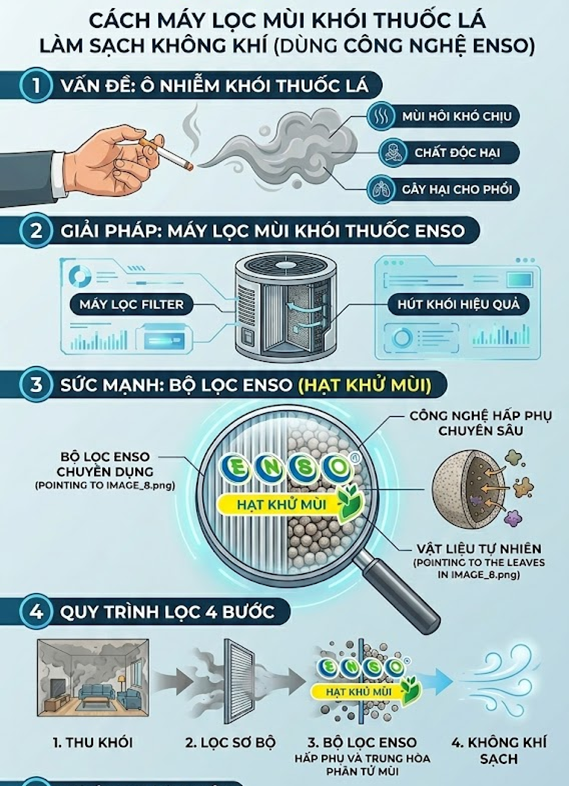
THE ADSORPTION MECHANISM OF ENSO DEODORIZING GRANULES
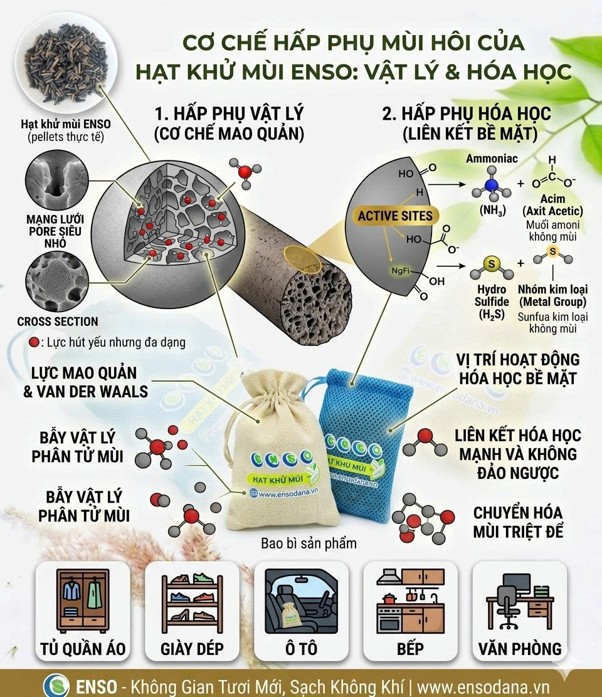
THE ADSORPTION MECHANISM OF ENSO DEODORIZING GRANULES
In modern life, unpleasant odors not only cause discomfort but also directly affect air quality and human health. From familiar spaces such as bathrooms, wardrobes, shoes, cars, kitchens, and offices, odor-causing molecules constantly exist and accumulate in the air. The problem is that most conventional deodorizing solutions merely mask odors with fragrances or use chemical agents, causing people to inhale substances that may not be truly safe on a daily basis. To eliminate odors thoroughly and sustainably, it is essential to understand the nature of odors and the scientific mechanisms behind their removal.
Unpleasant odors are actually composed of extremely small gas molecules such as ammonia (NH₃), hydrogen sulfide (H₂S), and volatile organic compounds (VOCs). These molecules diffuse rapidly through the air and easily adhere to the surfaces of surrounding materials, making odors persistent and difficult to eliminate completely. This is also why using air fresheners or scented sprays only provides temporary comfort, while the actual source of the odor remains and continues to spread.
A more effective solution lies in odor adsorption technology—a treatment method based on two main mechanisms: physical adsorption and chemical adsorption.
Physical adsorption works through materials containing millions of microscopic pores, creating capillary forces and natural molecular attraction. As odor-laden air passes through these materials, the odor molecules become trapped inside the porous structure, as if caught in an invisible network. This process occurs continuously without requiring energy or generating waste, helping reduce odors almost immediately.
However, the true advantage of advanced technology lies in the next step—chemical adsorption. Instead of simply trapping odor molecules, specially engineered active sites on the material's surface allow these molecules to undergo chemical reactions. Here, odor-causing compounds are either permanently bonded or converted into odorless substances, thereby eliminating odors at their source. These chemical bonds are highly stable and irreversible, meaning the odors cannot be released back into the environment.
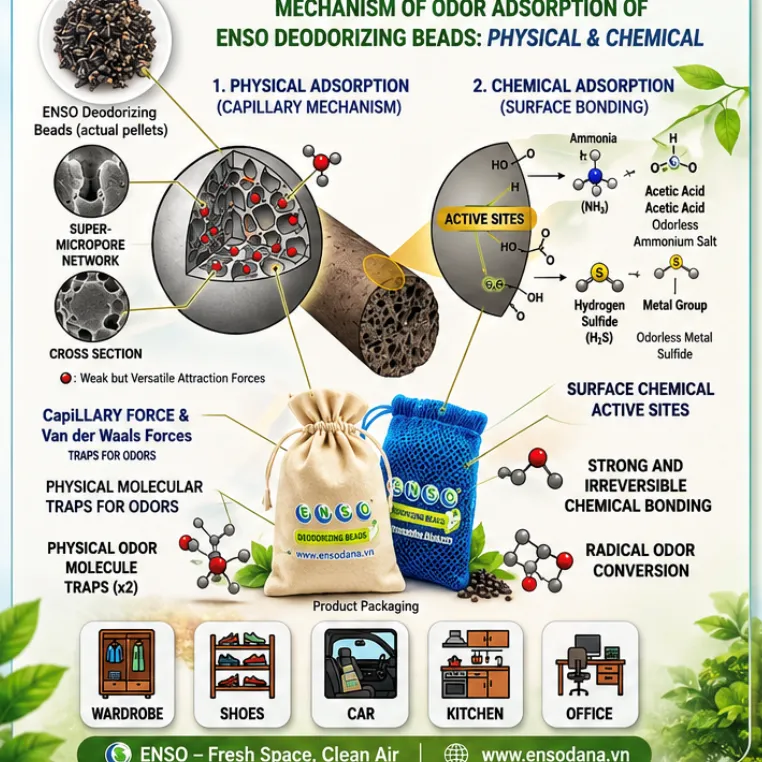
The combination of these two mechanisms creates a complete three-step odor treatment process: rapid adsorption, stable retention, and source-level decomposition. This is the core principle behind ENSO Deodorizing Granules—a solution developed to replace traditional deodorizing methods that rely heavily on chemicals. By applying dual adsorption technology, ENSO Deodorizing Granules do not release artificial fragrances, do not cause irritation, and are especially suitable for people who are sensitive to chemicals, children, and enclosed spaces where safety is a priority.
In practice, this technology can be applied flexibly in a wide range of environments, from personal spaces such as wardrobes and shoes to everyday living areas including kitchens, cars, and offices. In every application, the adsorption mechanism works quietly yet effectively, helping maintain clean, fresh, and stable indoor air over the long term.
It can be seen that odor control is not simply about creating a pleasant fragrance—it is about controlling and eliminating odor-causing compounds at their source. With an approach based on materials science and advanced adsorption technology, ENSO Deodorizing Granules provide a more sustainable solution for healthier living spaces—where there is no dependence on harsh chemicals, no lingering unpleasant odors, but instead a naturally clean, fresh, and balanced indoor environment.
Related posts

Are you struggling with unpleasant odors in your refrigerator or car, no matter what you've tried? Stop for just 30 seconds and discover ENSO's secret to eliminating odors at the source.

FOR A GREENER FUTURE, ENSO IS READY